Learning Outcome
By the end of this module, team members should understand how to respond safely if a dog becomes frightened, defensive, injured, involved in a fight, or causes or receives a bite during a Pad & Co booking. Team members should know how pain and fear can change behaviour, how to avoid escalation, when veterinary or medical advice may be needed, and when Pad & Co procedures and incident reporting must be followed.
Training Information
Pain, fear, stress or injury can change a dog’s behaviour quickly.
A dog that is normally friendly may behave differently if they are hurt, frightened, overwhelmed or trying to protect themselves.
A dog may:
- Growl
- Snap
- Bite
- Hide
- Freeze
- Panic
- Guard an injured area
- Try to run away
- Become reactive towards people or dogs
- Resist handling
- Become unusually quiet or withdrawn
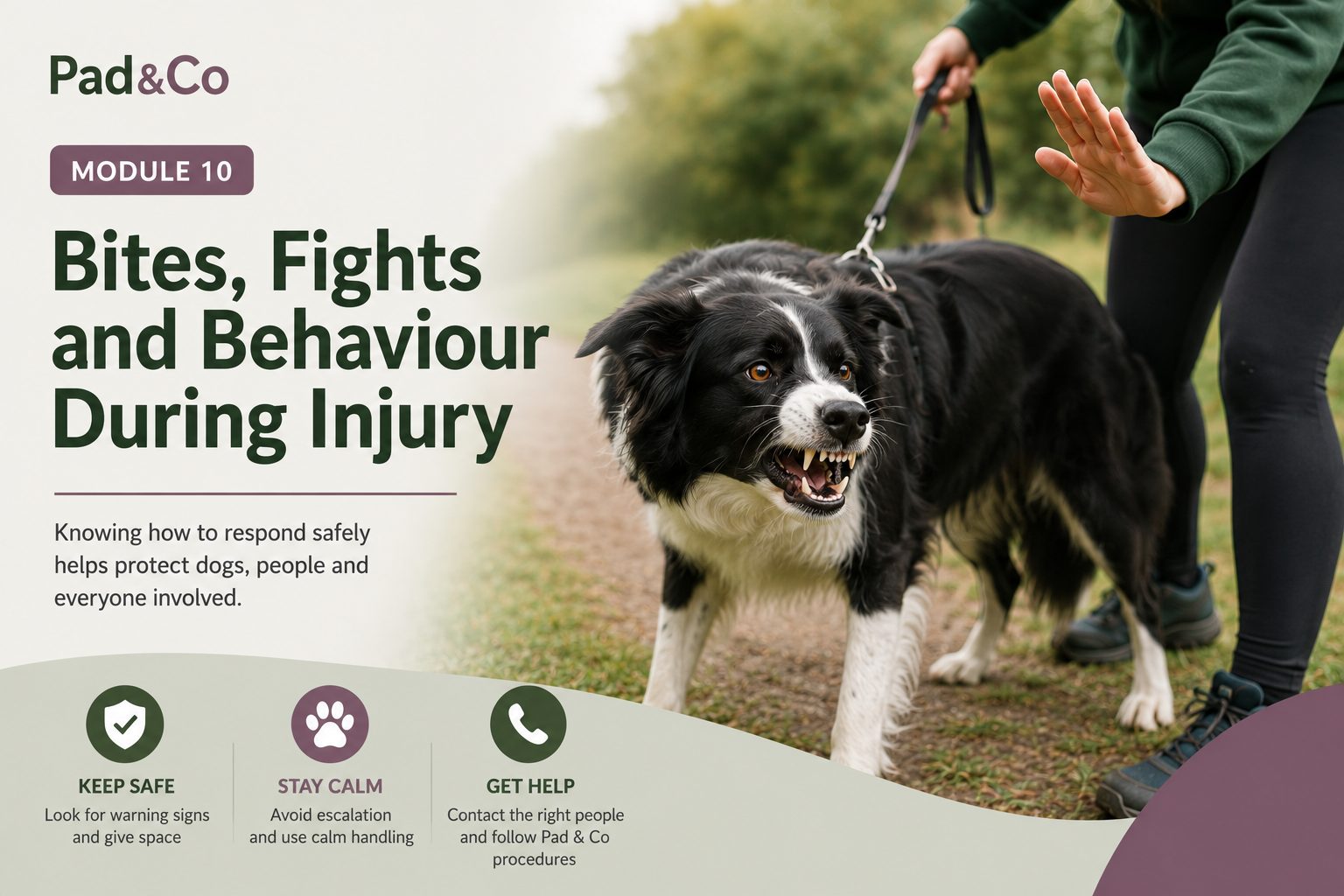
Warning signs must be taken seriously. Growling, freezing, moving away, showing teeth, stiff body posture or trying to hide are all signs that the dog needs space.
Team members must not punish warning signs. The priority is safety, space and calm handling.
Dog Fights
Dog fights can happen suddenly and may involve dogs that normally get along.
After a fight, injuries may not be obvious straight away. Small puncture wounds can be hidden under fur and may become painful or infected later.
Possible signs after a fight include:
- Limping
- Bleeding
- Puncture marks
- Swelling
- Licking one area
- Pain when touched
- Shaking
- Hiding
- Unusual quietness
- Growling or guarding
- Reluctance to move
Even if no injury is immediately visible, the incident should still be reported and monitored according to Pad & Co procedure.
What To Do If A Dog Fight Happens
If a fight or serious altercation happens during a Pad & Co booking:
- Stay calm.
- Keep yourself safe.
- Do not put hands between fighting dogs.
- Move other dogs, people and hazards away if safe.
- Separate dogs only if it can be done safely.
- Create distance and reduce stimulation.
- Check each dog from a safe distance.
- Contact Pad & Co management.
- Contact the client according to procedure.
- Seek veterinary advice where needed.
- Complete the incident form.
Bites To Dogs
If a dog is bitten by another dog or animal, the wound may be small on the surface but deeper underneath.
Team members should:
- Stop the activity.
- Keep the dog calm.
- Prevent further contact with the other dog or animal.
- Check for visible injuries only where safe.
- Avoid touching painful areas unnecessarily.
- Contact Pad & Co management.
- Contact the client according to procedure.
- Seek veterinary advice where needed.
- Complete the incident form.
Veterinary advice may be needed if there is bleeding, puncture wounds, swelling, pain, limping, shock, or any uncertainty.
Bites To People
If a person is bitten during a Pad & Co booking, the incident must be taken seriously.
Team members should:
- Make the area safe.
- Separate the dog from the person if safe.
- Encourage the person to seek medical advice where needed.
- Contact Pad & Co management immediately.
- Contact the client according to procedure.
- Record what happened clearly.
- Complete the incident form.
The report should include:
- Who was bitten
- Which dog was involved
- Where the bite happened
- What happened before the bite
- Whether there was broken skin
- Whether medical advice was needed
- Any witnesses
- What action was taken
Injured Or Defensive Dogs
An injured dog may become defensive because they are in pain or afraid.
Team members should:
- Give the dog space.
- Avoid crowding.
- Avoid sudden movements.
- Use a calm voice.
- Keep other dogs and people away.
- Avoid touching the injured area unless necessary and safe.
- Avoid forcing the dog to move unless there is immediate danger.
- Contact Pad & Co management.
- Seek veterinary advice where needed.
What Not To Do
Team members must not:
- Punish growling or warning signs.
- Grab at an injured or frightened dog.
- Put hands between fighting dogs.
- Crowd a dog that is trying to move away.
- Force handling if the dog is defensive.
- Ignore a bite because it looks small.
- Allow dogs involved in a fight to interact again during the same booking.
- Continue the booking as normal after a fight, bite or serious behaviour concern.
- Blame the dog or client in messages.
- Leave the incident unreported.
Behaviour After Injury
After an injury, fight or bite, a dog may remain unsettled even if they appear physically okay.
They may:
- Avoid contact
- Become clingy
- Become reactive
- Hide
- Refuse to walk
- Guard a body part
- Show stress signals
- Become more sensitive to touch
Team members should reduce pressure and avoid rushing the dog.
Information To Record
Team members should record:
- Date and time of the incident
- Location
- Dogs or people involved
- What happened before the incident
- What happened during the incident
- What happened after the incident
- Any visible injury
- Any behaviour changes
- Whether veterinary or medical advice was needed
- Who was contacted
- What action was taken
- Photos if appropriate and safe
Pad & Co Guidance
- Treat bites, fights and injury-related behaviour changes seriously.
- Keep yourself safe.
- Give dogs space.
- Do not punish warning signs.
- Do not place hands between fighting dogs.
- Separate dogs only if safe.
- Contact Pad & Co management.
- Contact the client according to procedure.
- Seek veterinary or medical advice where needed.
- Complete the incident form.
- Do not continue a booking as normal after a fight, bite or serious behaviour concern.
Key Points
- Pain and fear can change behaviour.
- Growling and avoidance are warning signs.
- Do not punish warning signs.
- Do not put hands between fighting dogs.
- Bites can be more serious than they first appear.
- Dogs involved in a fight should not be reintroduced during the same booking.
- Pad & Co procedure must be followed after bites, fights or serious behaviour concerns.