Learning Outcome
By the end of this module, team members should understand how to communicate clearly and professionally after an injury, illness, emergency or welfare concern during a Pad & Co booking. Team members should know what information to share, what language to avoid, when to contact Pad & Co management, when to contact the client, and when an incident form must be completed.
Training Information
Clear communication is important after any injury, illness, emergency or welfare concern.
Team members should communicate in a calm, factual and professional way.
The aim is to explain:
- What happened
- What signs were noticed
- What action was taken
- Who has been contacted
- What happens next
Team members should not diagnose, blame, exaggerate or minimise the situation.
A team member should describe what they can see, not what they think the condition is.
Factual Communication
Use clear facts.
Better wording:
- “I noticed bleeding from the front left paw.”
- “The dog was panting heavily and seemed weak.”
- “The dog collapsed during the walk.”
- “The dog may have eaten something from the kitchen floor.”
- “The dog was involved in an altercation with another dog.”
- “I have contacted Pad & Co management.”
- “I am following Pad & Co procedure.”
Avoid wording such as:
- “Your dog definitely has heatstroke.”
- “Your dog has poisoned itself.”
- “It is probably nothing.”
- “They are fine now, so no report is needed.”
- “The other dog was completely to blame.”
- “I treated it myself.”
Client Updates
Client updates should be:
- Calm
- Clear
- Factual
- Prompt
- Professional
A good client update should include:
- A brief explanation of what happened
- What signs were noticed
- What action has been taken
- Who has been contacted
- What will happen next
Client Message Structure
Use this structure as a guide when updating a client:
Hi [Client Name], I wanted to update you straight away.

During today’s booking, I noticed [brief factual description].

I have [action taken] and have contacted [Pad & Co management/vet if relevant].

We are following Pad & Co procedure and I will keep you updated clearly.
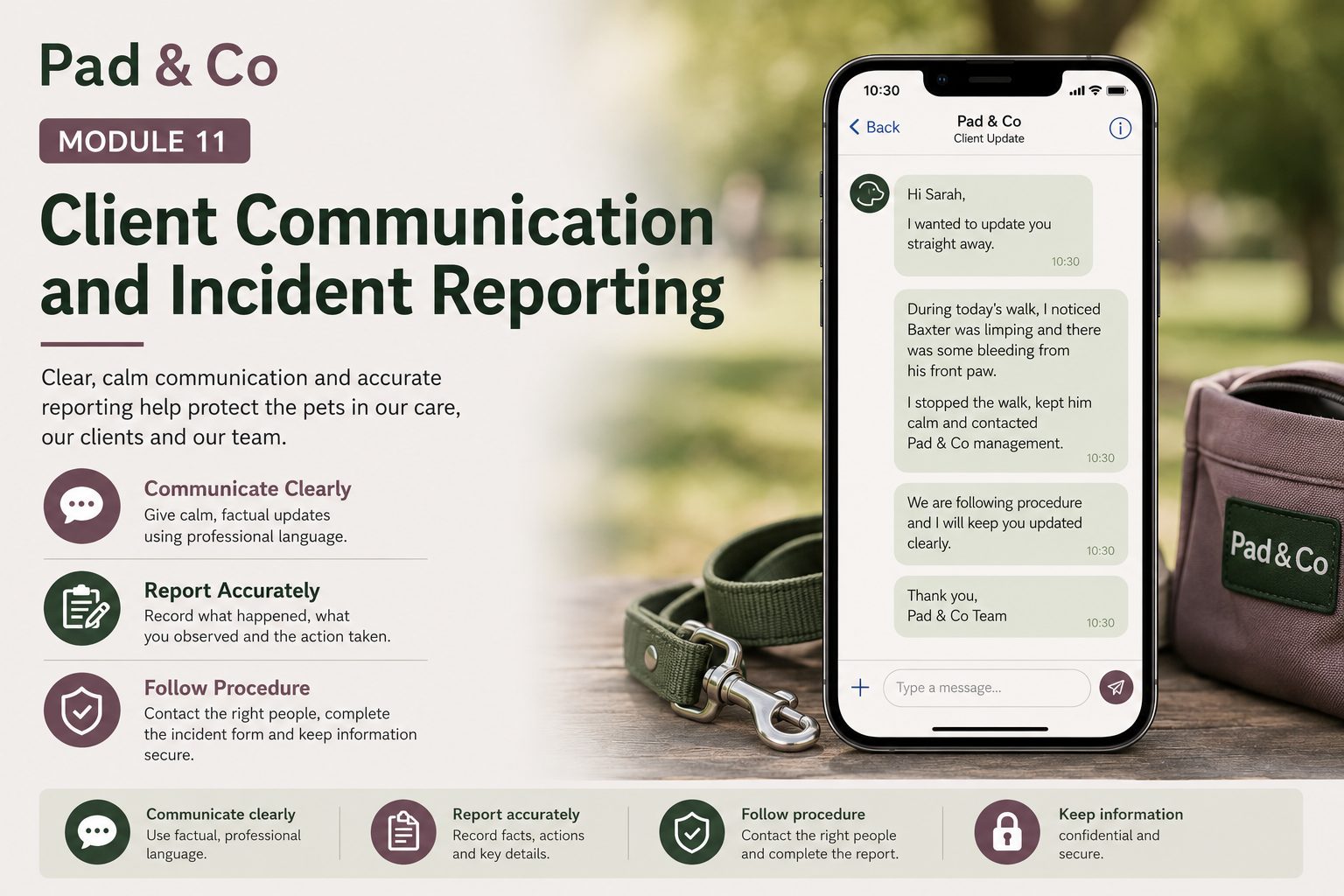
Example: Paw Injury
Hi [Client Name], I wanted to update you straight away.

During today’s walk, I noticed [Dog Name] was limping and there was some bleeding from their front paw.

I stopped the walk, kept them calm and contacted Pad & Co management. We are following procedure and I will keep you updated clearly.
Example: Heat Concern
Hi [Client Name], I wanted to update you straight away.

During today’s booking, I noticed [Dog Name] was panting heavily, seemed weak and was struggling in the warm weather.

I moved them into shade, started safe cooling and contacted Pad & Co management. We are following procedure and veterinary advice may be needed.
Example: Possible Poisoning
Hi [Client Name], I wanted to update you straight away.

I am concerned that [Dog Name] may have eaten or contacted something unsafe.

I have moved them away from it, kept details/photos where safe, and contacted Pad & Co management. We are following procedure and veterinary advice may be needed.
Example: Dog Fight Or Bite
Hi [Client Name], I wanted to update you straight away.

During today’s booking, [Dog Name] was involved in an incident with another dog.

I separated the dogs where safe, checked [Dog Name] from a safe distance and contacted Pad & Co management. We are following procedure and I will keep you updated clearly.
Incident Reporting
An incident form should be completed after any event that could affect the pet’s welfare, the client, the team member, the public or Pad & Co records.
This includes:
- Injury
- Illness
- Bleeding
- Paw injury
- Broken nail
- Collapse
- Seizure
- Choking or breathing difficulty
- Suspected poisoning
- Heat concern
- Road accident
- Fall or heavy impact
- Suspected broken bone
- Dog fight
- Bite to a dog
- Bite to a person
- Escape or near escape
- Behaviour concern
- Any unusual event that may need a record
If unsure, complete the incident form or contact Pad & Co management.
What To Record
The incident record should include:
- Date and time
- Booking type
- Pet name
- Client name
- Location
- What happened
- What was noticed
- Any visible signs
- Action taken
- Who was contacted
- Any veterinary advice given
- Any client instructions
- Whether photos were taken
- Whether follow-up is needed
The record should be factual and clear.
What Not To Do
Team members must not:
- Diagnose the pet’s condition.
- Blame the client, pet, team member or another dog.
- Exaggerate what happened.
- Minimise a serious concern.
- Promise that the pet is fine.
- Delay reporting.
- Leave an incident undocumented.
- Use emotional or defensive wording.
- Share incident details publicly or on social media.
- Discuss another client’s pet or private information.
Confidentiality
Incident information should only be shared with the correct people.
This may include:
- Pad & Co management
- The client
- Veterinary professionals where needed
- Relevant team members where appropriate
Team members must not share incident details with unrelated clients, members of the public or on social media.
Pad & Co Guidance
- Communicate clearly and calmly.
- Use factual wording.
- Do not diagnose.
- Do not blame.
- Do not minimise.
- Contact Pad & Co management where required.
- Contact the client according to procedure.
- Complete the incident form promptly.
- Keep client and pet information confidential.
- If unsure, ask Pad & Co management.
Key Points
- Clear communication protects the pet, client, team member and business.
- Describe what happened, do not diagnose.
- Avoid blame-based or emotional wording.
- Incident forms should be completed promptly.
- If unsure whether to report something, report it or ask a manager.
- Client and pet information must remain confidential.