Learning Outcome
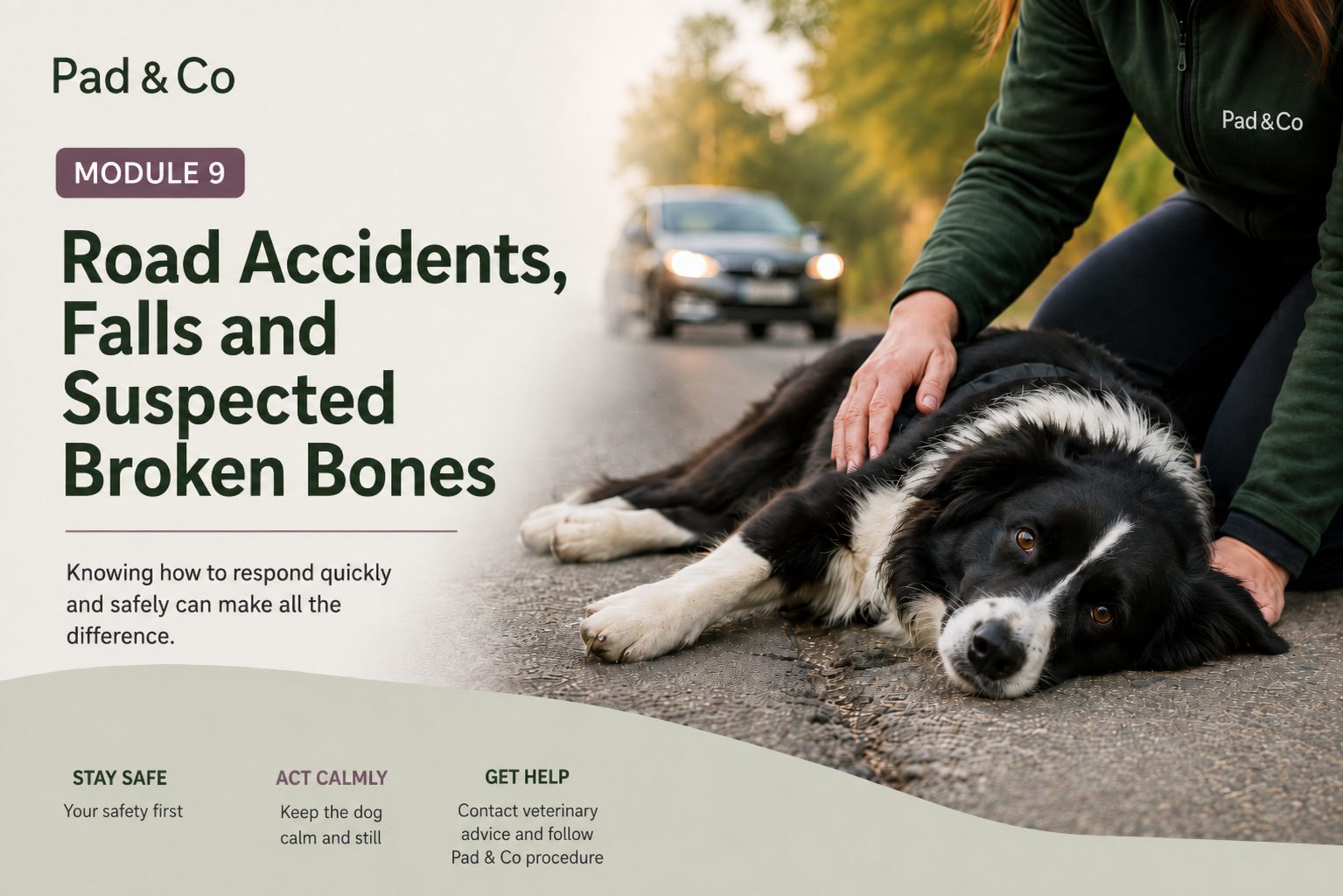
By the end of this module, team members should understand how to respond safely if a dog is involved in a road accident, fall, heavy impact or suspected broken bone during a Pad & Co booking. Team members should know how to keep themselves safe, when to avoid moving the dog, when veterinary advice is needed, and when Pad & Co procedures and incident reporting must be followed.
Training Information
Road accidents, falls, heavy impacts and suspected broken bones should always be treated seriously.
A dog may appear alert after an accident but still have injuries that are not easy to see. Internal injuries, shock, pain or fractures may not be obvious straight away.
Possible situations include:
- A dog being hit by a vehicle
- A dog slipping or falling
- A dog jumping awkwardly
- A dog being knocked over by another dog
- A dog running into an object
- A dog suddenly becoming unable to walk normally
- A dog showing signs of severe pain after impact
If a road accident, fall or heavy impact happens during a Pad & Co booking, team members must stop the activity and follow emergency procedure.
Possible Signs Of Injury
Signs may include:
- Limping
- Holding up a leg
- Crying, yelping or whining
- Reluctance to move
- Swelling
- Bleeding
- Fast breathing
- Pale, blue or abnormal gums
- Collapse
- Shaking
- Hiding
- Unusual quietness
- Sensitivity when touched
- Obvious change in posture
- A limb sitting at an unusual angle
A dog in pain may also growl, snap or try to move away, even if they are normally friendly.
What To Do
If a dog is involved in a road accident, fall, heavy impact or suspected broken bone during a Pad & Co booking:
- Stop the activity immediately.
- Keep yourself safe.
- Do not step into traffic or danger.
- Move other dogs, people or hazards away if safe.
- Keep the dog calm and still where possible.
- Avoid unnecessary movement.
- Contact veterinary advice urgently.
- Contact Pad & Co management.
- Contact the client according to procedure.
- Complete the incident form.
Road Accident Guidance
If a dog has been hit by a vehicle:
- Do not put yourself in danger.
- Do not stand in the road unless it is safe.
- Do not chase the dog if this could push them into more danger.
- Keep the dog calm if they are safe to approach.
- Contact veterinary advice urgently.
- Contact Pad & Co management.
- Contact the client according to procedure.
- Complete the incident form.
Even if the dog appears okay, veterinary advice is still needed after a road accident.
Falls And Heavy Impacts
If a dog falls, slips, lands awkwardly or is knocked heavily:
- Stop the activity.
- Watch for limping, pain, weakness or reluctance to move.
- Keep the dog calm.
- Avoid forcing the dog to walk.
- Contact veterinary advice if there is pain, limping, collapse, bleeding, shock or uncertainty.
- Follow Pad & Co procedure.
Some injuries can appear worse after the dog has rested or once adrenaline wears off.
Suspected Broken Bones
A suspected broken bone should be treated as urgent.
Possible signs include:
- Severe limping
- Not putting weight on a leg
- Crying or yelping
- Swelling
- Limb at an unusual angle
- Refusing to move
- Pain when touched
- Shock or collapse
Team members must not:
- Try to straighten the limb.
- Force the dog to walk.
- Pull or move the injured leg.
- Splint the limb unless directly instructed by a veterinary professional.
- Give medication.
- Delay veterinary advice.
Moving The Dog
Avoid moving the dog unless:
- They are in immediate danger.
- Veterinary advice tells you to move them.
- They must be moved to prevent further harm.
If the dog must be moved, keep movement as minimal and gentle as possible.
Do not lift a dog if doing so could make the injury worse or put the team member at risk.
What Not To Do
Team members must not:
- Continue the walk or booking as normal.
- Put themselves in traffic or danger.
- Force the dog to stand or walk.
- Assume the dog is fine because they seem alert.
- Straighten a suspected broken limb.
- Give human medication or painkillers.
- Move the dog unnecessarily.
- Delay veterinary advice.
- Ignore shock, collapse or pale gums.
- Leave the incident unreported.
Information To Record
Team members should record:
- What happened
- Where it happened
- Time of the incident
- Whether a vehicle, fall or impact was involved
- Signs seen
- Whether the dog could stand or walk
- Any bleeding, swelling or visible injury
- What action was taken
- Who was contacted
- Any advice given by the vet, manager or client
- Photos if appropriate and safe
Pad & Co Guidance
- Treat road accidents, heavy falls and suspected broken bones as serious.
- Keep yourself safe first.
- Stop the activity immediately.
- Keep the dog calm and still where possible.
- Avoid unnecessary movement.
- Contact veterinary advice urgently.
- Contact Pad & Co management.
- Contact the client according to procedure.
- Complete the incident form.
- Do not continue a booking as normal after an accident, fall or suspected fracture.
Key Points
- Staff safety comes first.
- Road accidents should be treated as serious, even if the dog seems okay.
- Falls and heavy impacts can cause hidden injuries.
- Suspected broken bones need veterinary advice.
- Do not force the dog to walk.
- Do not straighten or splint a limb unless directly instructed by a veterinary professional.
- Pad & Co procedure must be followed after any accident, fall, heavy impact or suspected broken bone.